Practice set
California contractor business finances practice
Free preview: 24 questions. View study pass options for full access.
Included with the California Contractor study pass
The California Contractor Pass Kit: 5 printable study guides
Preview the printables below. Study pass holders can get the full PDFs from account downloads.
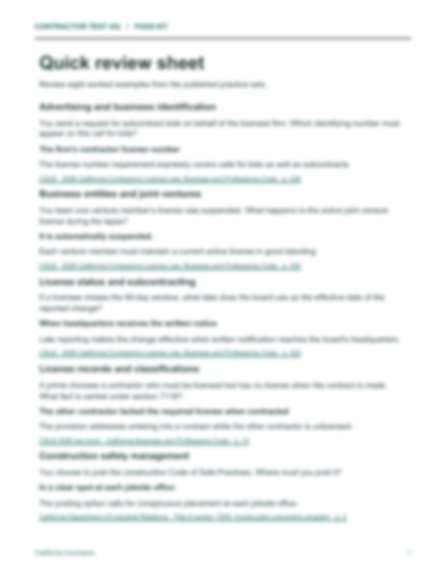
Quick review sheet
Review eight worked examples from the published practice sets.
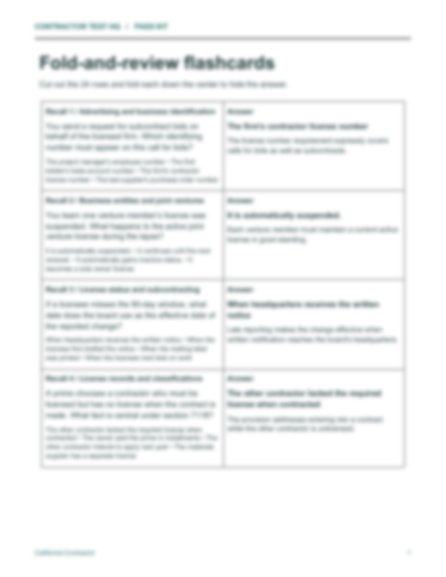
Fold-and-review flashcards
Cut out the 24 rows and fold each down the center to hide the answer.
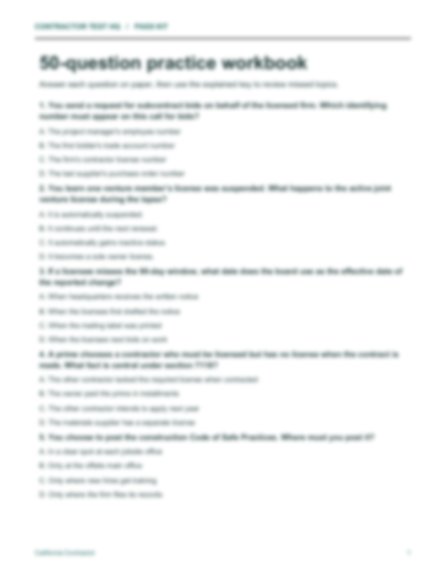
50-question practice workbook
Answer each question on paper, then use the explained key to review missed topics.
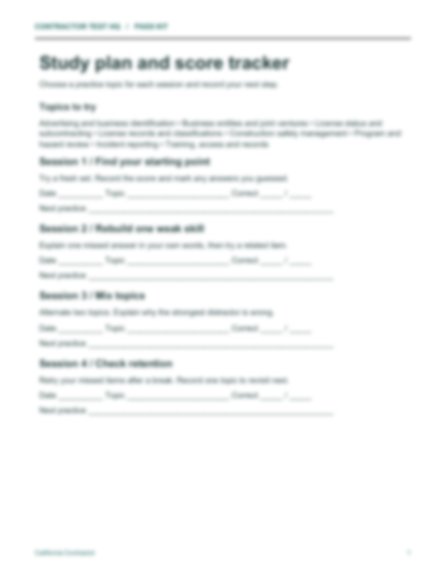
Study plan and score tracker
Choose a practice topic for each session and record your next step.
Exam day checklist
Review the format and fill in your appointment details before you go.
Distinguish markup from gross margin
A contractor’s direct cost for a job is $8,000. The bid adds a 25% markup on that cost. What is the gross margin as a percentage of the selling price?
Check your reasoning
The markup is $2,000 and the selling price is $10,000. Divide the $2,000 gross profit by the $10,000 price to get a 20% gross margin. Markup uses cost as its denominator. Margin uses revenue.
Further reading: Penn State Extension · What’s the Difference Between Markup and Profit?
Choose a topic to practice
Cash, receipts and retention
Cash, receipts and retention.
9 questions in the bankGross margins and cost forecasts
Gross margins and cost forecasts.
6 questions in the bankJob costs and shared overhead
Job costs and shared overhead.
6 questions in the bankWorking capital and balance sheets
Working capital and balance sheets.
3 questions in the bankReconciling the operating account
A contractor’s November statement ends at $18,220. A $2,400 customer deposit recorded in November reached the bank on December 1. The November ledger includes checks for $740 and $980 that had not cleared. The ledger balance is $18,935 before a $35 bank fee.
4 questions in the bankClosing the site cash box
A site has a $200 petty cash fund. At Friday’s count it holds $126 in currency and signed slips for $28 parking, $16 delivery and $25 replacement hardware. The supervisor requires a receipt with each slip when available.
3 questions in the bankIdentifying the source of a deposit
A sole proprietor’s business account shows one $12,000 deposit. The deposit worksheet lists $7,100 from a customer invoice, $3,000 from the owner’s personal savings and $1,900 from a bank loan. All three transfers are documented.
3 questions in the bankMaintaining the equipment file
A contractor buys a used compressor, pays separately for delivery, and places it in service six weeks later. Years afterward the compressor is sold. The equipment file contains the invoice, freight receipt and annual depreciation schedules.
3 questions in the bankMatching cleared payments
The statement shows one $846 payment to a pump supplier. The invoice and cleared check both show $846, but the bookkeeper entered $684. Separately, a check to an insulation supplier has been printed but has yet to be delivered or posted.
3 questions in the bankMoving project records to electronic storage
A builder is replacing paper bookkeeping files with scanned records. The proposed system stores invoices by year, retrieves them by supplier and can reproduce readable copies. Several source pages in a trial import are missing their reverse sides.
3 questions in the bankSeparating the cash draw from the day’s receipts
An office cash drawer starts with a $60 change fund. It ends with $466 cash after a documented $24 business payment from the drawer. There were no owner withdrawals, refunds, new change funds or other cash movements.
3 questions in the bankSubstantiating a parts purchase
A repair contractor buys replacement fittings for resale. A bank transfer identifies the supplier, date and dollars paid. The supplier’s separate invoice lists the fittings and quantity. A third document is an unaccepted quote for different fittings.
3 questions in the bankPayroll taxes and EDD reporting
Reconcile quarterly filings, wage reports and worker registry records.
24 questions in the bankSales and use tax for construction jobs
Compare California tax treatment for materials, fixtures, machinery and installation.
24 questions in the bank